I am going to be honest about something that might sound strange: fermented food changed my relationship with my own body more than any supplement, any diet, or any wellness trend I have ever tried.
And I came to it reluctantly. The smell of sauerkraut used to make me leave the room. Kombucha tasted like someone had carbonated vinegar and called it a health drink. I did not understand why anyone would eat these things voluntarily.
Then I learned what they do — not on a label, not from an influencer, but from the research. And once I understood the mechanism, I could not unlearn it. I have been eating fermented foods consistently for eleven months now, and the changes in my digestion, my skin, and my energy are not subtle.
Why Fermented Food Is Different From Everything Else
Most nutritional advice focuses on what nutrients you are putting into your body — vitamins, minerals, protein, fibre. Fermented foods do something fundamentally different. They deliver live microorganisms directly into your gut, where those organisms take up residence and begin working.
This is not a metaphor. Research published in Cell found that participants who ate a high-fermented-food diet for ten weeks showed measurably increased microbial diversity in their gut — and that diversity correlated directly with reduced markers of systemic inflammation. Not supplementation. Not probiotics in capsule form. Actual food.
The distinction matters because capsule probiotics face a survival problem. Many of the bacteria in commercial supplements do not survive stomach acid long enough to colonise the intestine. Fermented foods, however, deliver bacteria in a food matrix that protects them through digestion. The bacteria arrive alive, and they arrive with the substrates they need to thrive.
"You cannot supplement your way to a healthy gut. You have to feed it. Fermented foods do not just deliver bacteria — they deliver the environment those bacteria need to survive."
What I Eat and Why Each One Matters
This is not an exhaustive list. This is what I actually eat, every week, consistently.
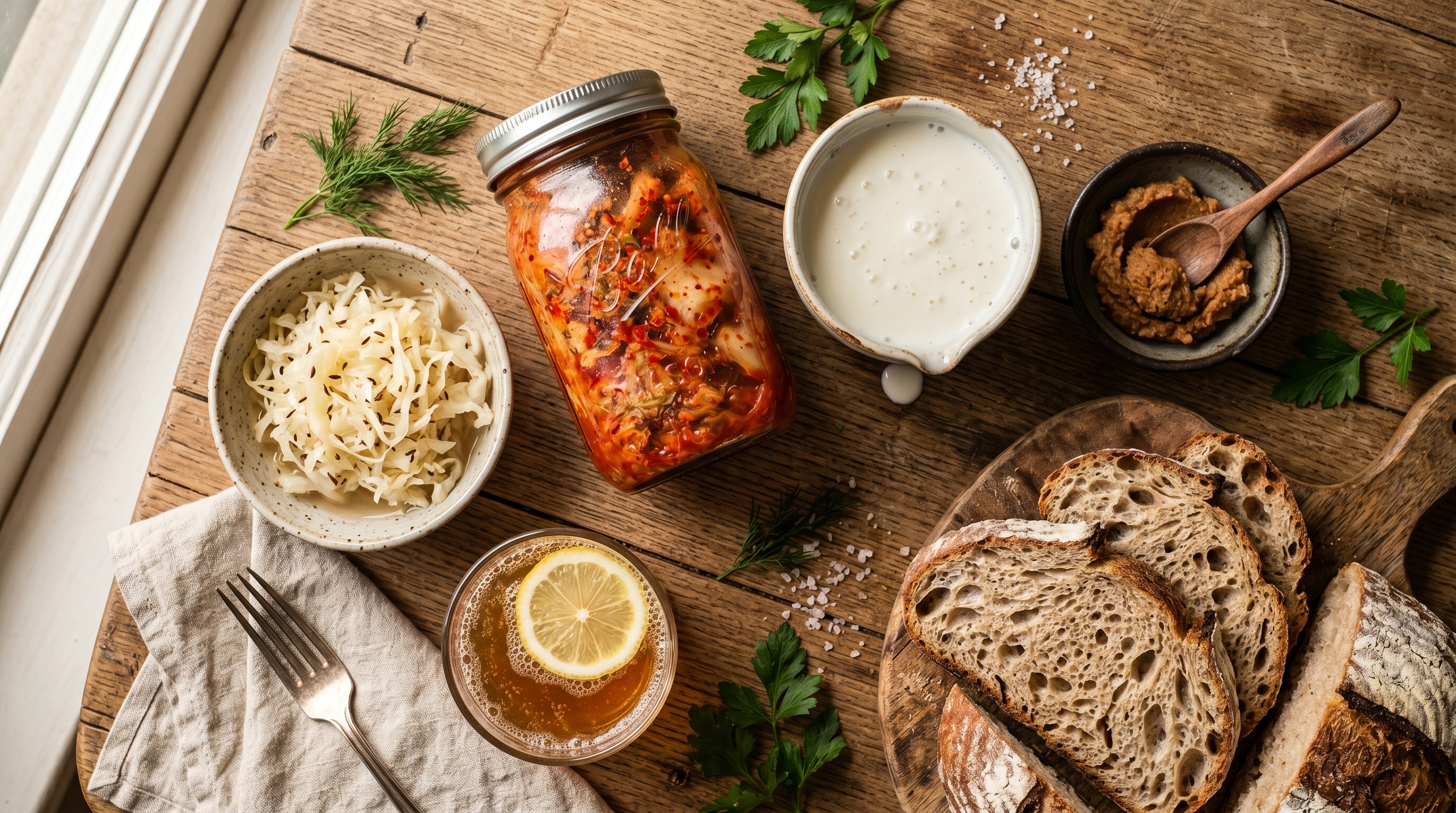
Sauerkraut — the foundation. Raw, unpasteurised sauerkraut (the kind sold refrigerated, not shelf-stable) contains Lactobacillus plantarum and Leuconostoc mesenteroides — strains that research published in the World Journal of Microbiology and Biotechnology has shown to reduce intestinal inflammation and improve nutrient absorption. I eat two to three tablespoons with lunch, usually beside whatever protein I am having. The taste is sharp and salty, and I have grown to crave it in a way I never expected.
Kimchi — the powerhouse. Kimchi contains everything sauerkraut does, plus additional strains from the garlic, ginger, and chili in the fermentation process. A study in the Journal of Medicinal Food found that regular kimchi consumption was associated with improved cholesterol profiles and reduced markers of oxidative stress. I eat it three to four times a week, usually with rice or eggs.
Kefir — the daily habit. Kefir is fermented milk, and it contains a broader range of bacterial strains than yogurt — typically 30 to 50 different species compared to yogurt's two to five. Research published in the journal Nutrients found that kefir consumption improved lactose digestion even in lactose-intolerant individuals, because the bacteria in kefir produce their own lactase enzyme. I drink a small glass most mornings. It tastes like drinkable yogurt with a slight tang.
Miso — the quiet worker. Miso is fermented soybean paste, and it contains Aspergillus oryzae — a fungus that produces enzymes aiding protein digestion. A long-term population study published in the American Journal of Clinical Nutrition found that daily miso consumption was associated with reduced risk of cardiovascular events in Japanese women. I dissolve a tablespoon in hot water for a broth two or three times a week, usually in the evening.
Sourdough bread — the surprise. Real sourdough — made with a live starter culture, not commercial yeast — undergoes a fermentation process that partially breaks down gluten and phytic acid, making the bread more digestible and its minerals more bioavailable. Research in Applied and Environmental Microbiology found that sourdough fermentation reduced the glycemic index of bread by up to 25% compared to conventional bread made from the same flour. I eat one or two slices a few times a week, toasted with butter.
What Changed After Eleven Months
Month one: the bloating I had accepted as normal reduced significantly. Not eliminated — but the daily distension I felt after lunch softened into something barely noticeable. This aligns with research showing that Lactobacillus strains from fermented food reduce gas production by outcompeting gas-producing bacteria.
Month three: my skin began to clear in a way that no topical product had achieved. The connection between gut health and skin is well-documented — a review in the journal Gut Pathogens called it the "gut-skin axis" and found that intestinal dysbiosis directly contributes to inflammatory skin conditions including acne, rosacea, and eczema. By restoring bacterial diversity in my gut, I was reducing the inflammatory signals that showed up on my face.
Month six: my immune resilience changed. I went through an entire winter without the usual cycle of colds that had been my annual pattern. This is consistent with the fact that approximately 70% of the immune system is located in the gut, and microbial diversity directly supports immune regulation.
Month eleven (now): the most lasting change is consistency. My digestion is predictable. My energy after meals is stable. The afternoon crash that used to send me looking for sugar has become rare. And the food itself — the sauerkraut, the kimchi, the kefir — has become something I genuinely enjoy, not something I endure for health reasons.
How to Start Without Overwhelming Yourself
If you are not eating any fermented food currently, do not try to add all five at once. Start with one. I would suggest kefir or sauerkraut — they are the most widely available, the most studied, and the easiest to incorporate.
Week one: add two tablespoons of raw sauerkraut to one meal per day. Or drink half a cup of kefir in the morning.
Week three: add a second fermented food. Kimchi with dinner, or miso broth in the evening.
Month two: your gut bacteria have had time to adjust. You can experiment more freely — sourdough, kombucha, fermented pickles.
The key principle: consistency over quantity. A small amount of fermented food eaten every day does more for your microbiome than a large amount eaten once a week. The bacteria need regular reinforcement to establish themselves.
Start small. Stay consistent. And pay attention to what your body does when you finally give it what it has been quietly asking for.
— Seraphina
Join the Inner Circle
Seraphina's Weekly Letters
Weekly wellness notes for women who are quietly becoming.