Something shifted in how I understood my own mind when I learned that ninety percent of the body's serotonin is produced in the gut.
Not in the brain. In the gut.
The neurotransmitter most associated with mood stability, with the feeling that things are fundamentally okay, with the capacity to handle difficulty without collapsing — ninety percent of it originates in the intestinal lining, produced by cells that are in constant communication with the microorganisms living there.
This is not alternative medicine. This is current neuroscience. And it changes the conversation about mood, anxiety, mental clarity and emotional resilience in ways that most of us have not been given access to.
The second brain
Your gut contains approximately 500 million neurons — more than your spinal cord. It communicates with your brain via the vagus nerve, a pathway so significant that researchers now call the gut the "second brain," not as a metaphor but as a functional description.
This communication is bidirectional — your brain talks to your gut and your gut talks back. But the majority of the signals travel upward, from gut to brain, rather than the reverse. Your gut is sending your brain more information than your brain is sending your gut.
What your gut sends depends on what is living there. The gut microbiome — the ecosystem of trillions of bacteria, fungi and other microorganisms in your digestive tract — produces neurotransmitters, regulates inflammation, trains your immune system and influences the chemical environment your brain operates in.
When the microbiome is diverse and well-fed, the signals it sends are stabilising. When it is depleted — through poor diet, antibiotics, chronic stress, alcohol or a combination — the signals shift. Inflammation increases. Neurotransmitter production changes. The brain, receiving different inputs, produces different outputs.
What this feels like: anxiety that has no clear trigger. A low mood that does not correspond to your circumstances. Brain fog that coffee does not fix. Irritability that arrives before you have a reason to be irritable.
These are not personality traits. They are, at least in part, reports from your gut.
What depletes the microbiome
Before talking about what to eat, it is worth understanding what is working against you — because most women are unknowingly doing multiple things simultaneously that compound over time.
Ultra-processed foods. Not because they are calorie-dense but because they are microbiome-poor. They contain no fibre, which is the primary food source of beneficial gut bacteria. Without fibre, beneficial bacteria starve and reduce in number. Less diverse microbiome, fewer stabilising signals to the brain.
Chronic stress. Cortisol alters gut motility, changes the composition of the microbiome, and increases intestinal permeability — a condition commonly called "leaky gut," where the gut lining becomes porous enough that bacterial products enter the bloodstream and trigger systemic inflammation. This inflammation reaches the brain and produces the neuroinflammatory symptoms that look remarkably like depression and anxiety.
Antibiotics. Necessary when necessary. But each course significantly reduces microbiome diversity and takes months to partially recover from, longer if the diet does not actively support recolonisation.
Alcohol. Even moderate regular consumption alters microbiome composition in ways that reduce beneficial bacteria and increase pro-inflammatory species. This is part of why the day after drinking feels emotionally as well as physically difficult — the gut signal has changed.
What actually helps
A 2021 Stanford study had participants eat a high-fibre diet versus a high-fermented-food diet for ten weeks. The fermented food group — eating yogurt, kefir, kimchi, kombucha, miso, sauerkraut — showed measurably increased microbiome diversity and significantly reduced inflammatory markers. The effect was dose-dependent: more variety of fermented foods, greater the benefit.
This is the most practical finding in gut health research for everyday eating. You do not need a protocol. You need variety and fermentation.
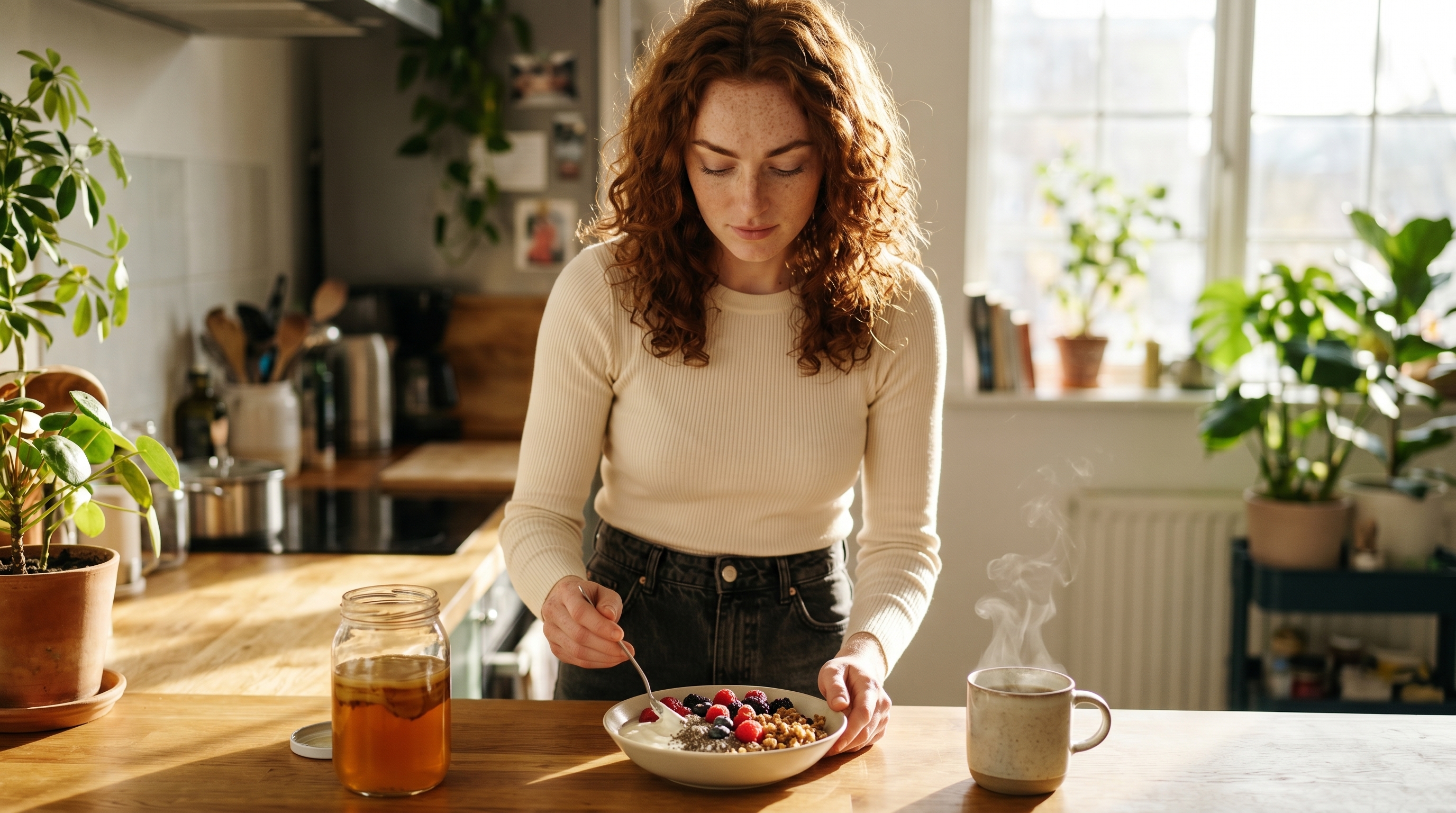
Fermented foods — daily if possible. Full-fat live yogurt with real cultures, not the sugar-laden versions marketed as healthy. Kefir, which has significantly more bacterial strains than yogurt. Kimchi or sauerkraut as a side — a tablespoon is enough. Kombucha as a drink. Miso stirred into soups or dressings.
The goal is not any single food. It is diversity of bacterial exposure over time.
Prebiotic fibre — the food your bacteria eat. Garlic, onion, leeks, asparagus, green bananas, oats, chicory, Jerusalem artichoke. These are the foods that feed the beneficial bacteria already in your gut. Fermented foods add new bacteria. Prebiotic foods feed the ones you have.
Polyphenols — the compounds that make colour. Blueberries, dark chocolate, extra virgin olive oil, green tea, red wine in small quantities. Polyphenols are selectively used by beneficial gut bacteria and have been shown to increase their diversity. The simplest instruction: eat as many different colours of vegetables and fruits each week as you can manage.
Reducing the inputs that damage the ecosystem. This does not require elimination. It requires honest assessment. How many days a week are you eating something fermented? How much variety does your diet have? How often are you eating in ways that feed beneficial bacteria versus ways that starve them?
The connection that changed how I eat
I used to eat for how I looked. Then I ate for energy. Now I eat for how I think and feel — because those things, I have learned, are more directly connected to what is happening in my gut than to almost anything else.
The anxiety that used to feel like a personality trait has become quieter in weeks where I eat well. The brain fog that I attributed to tiredness clears faster when my gut is well-fed. The low mood that sometimes arrives for no apparent reason is less frequent and shorter when I am eating in ways that support the microbiome.
I cannot tell you these things with the certainty of a controlled trial. I can tell you that the science supports the mechanism and the personal experience has been consistent enough that I no longer treat it as coincidence.
Your gut is talking to your brain all day. What it says depends on what you feed it.
That is the most empowering piece of health information I have ever come across. Because it means that how you feel is not fixed. It is, at least in part, editable.
Start editing.
Join the Inner Circle
Seraphina's Weekly Letters
Weekly wellness notes for women who are quietly becoming.