
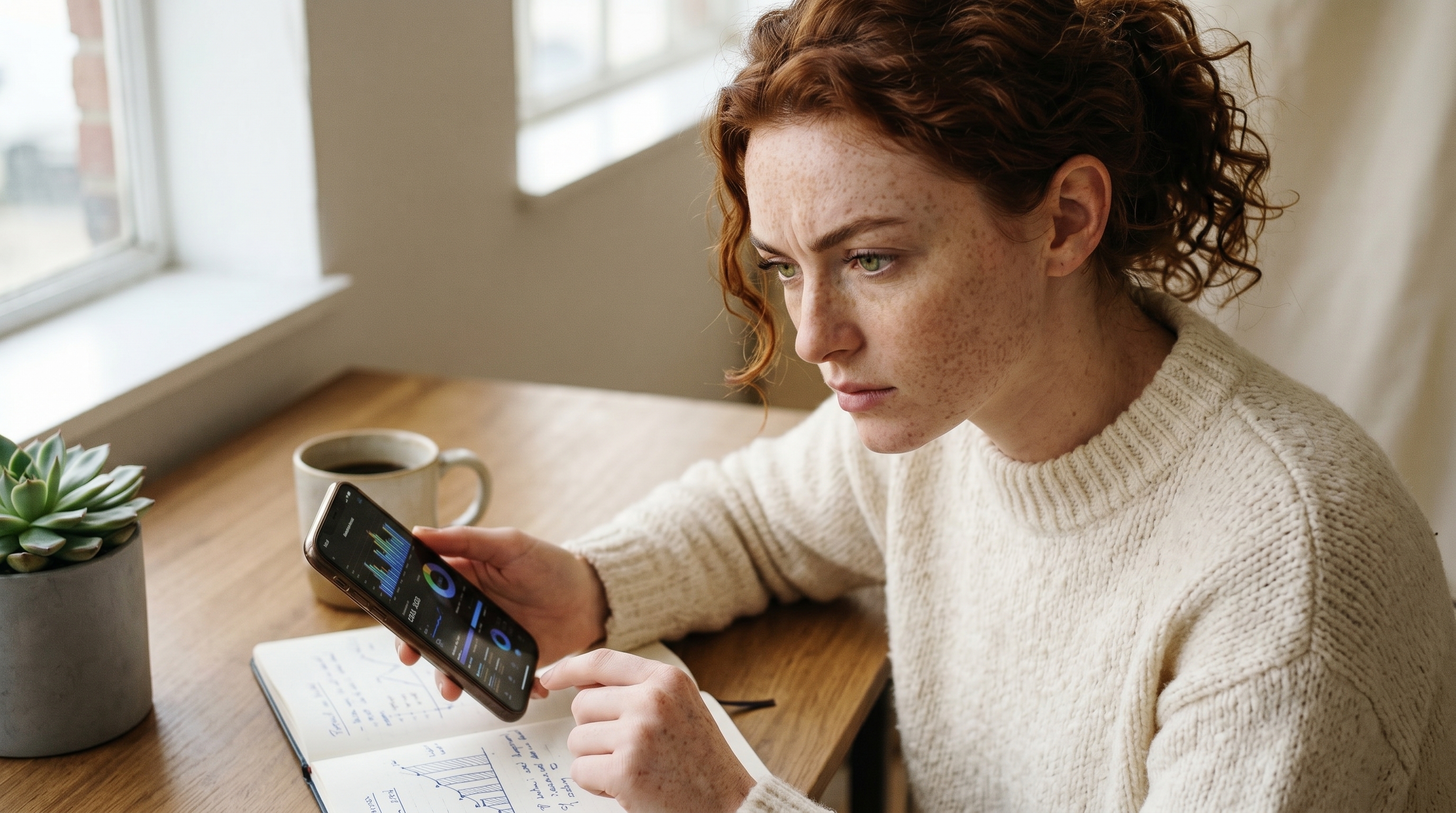
I have a complicated relationship with sleep trackers.
On one hand, data is useful. On the other hand, I have seen what happens when women become so focused on their sleep score that the anxiety about achieving a good score actually disrupts their sleep. This is a real, documented phenomenon now called orthosomnia — obsessive concern with achieving perfect sleep metrics.
So when I decided to compare three sleep trackers over sixty days, I gave myself one rule. The data only mattered if it matched what I actually felt. If a tracker said I slept brilliantly and I woke up exhausted, the tracker was wrong for me, regardless of what the algorithm claimed.
Here is what sixty days taught me.
What I was comparing
A wearable ring, a wearable wrist tracker, and a non-wearable bedside sensor that tracks through subtle vibration and audio. I rotated through each for roughly three weeks, with some overlap periods where I wore two simultaneously to compare directly.
I was looking at three things: how closely the data matched my subjective experience, how actionable the insights actually were, and whether using the tracker changed my behaviour in a way that mattered.
The ring
The ring was, by a meaningful margin, the most accurate at detecting when I actually fell asleep versus when I was lying still but awake. This distinction matters more than people realise — many trackers conflate stillness with sleep, which inflates your reported sleep time.
Where it struggled: distinguishing sleep stages with the precision the app implied. The deep sleep and REM breakdowns felt more like an estimate dressed up as a measurement. I cross-referenced nights where I felt clearly rested against nights it scored highly and there was correlation, but not the tight precision the interface suggested.
What I found most useful: the morning readiness score, which factored in heart rate variability overnight. This metric correlated more consistently with how I actually felt than the sleep score itself did. On mornings the readiness score was low, I felt low. That consistency built trust.
What I found least useful: the sleep score breakdown by stage. I stopped looking at this within two weeks because it created a kind of anxious checking behaviour rather than useful information.
The wrist tracker
Less accurate at distinguishing actual sleep onset — it consistently reported me falling asleep ten to fifteen minutes earlier than I knew I had, based on what I remembered doing in bed beforehand.
Where it excelled: daytime activity correlation. It was the only one of the three that effectively showed me the relationship between my activity levels during the day and my sleep quality that night. On days I walked over 8,000 steps, my sleep scores were measurably and consistently higher across the sixty days. This was the single most useful insight from any of the three trackers — not because the sleep tracking itself was best, but because it connected sleep to a daytime behaviour I could actually control.
What I found least useful: the stress tracking feature. It flagged "high stress" on days I felt calm and missed genuinely stressful days entirely. I stopped trusting this feature by week three.
The bedside sensor
The least invasive — no wearable required, which matters for women who find sleeping with a ring or wrist device uncomfortable or who simply forget to charge it.
Accuracy was reasonable but noticeably worse on nights with a partner or pet in the bed — the device struggled to distinguish my movement and breathing from ambient movement in the room. On nights I slept alone, the data was closer to my subjective experience than I expected from a non-contact device.
What I found most useful: the snoring and environmental noise tracking. I discovered noise disruptions in my sleep environment I was not consciously aware of — a neighbour's early morning routine, a partner's snoring on certain nights — that were affecting my sleep without me realising the cause.
What I found least useful: anything related to sleep stage breakdown. The technology simply is not precise enough for this without direct contact, and the app presented stage data with a confidence the underlying measurement did not support.
What actually changed my sleep across sixty days
Not the tracking itself. The behaviour changes the tracking prompted.
Seeing the consistent correlation between daytime steps and sleep quality on the wrist tracker made me prioritise a daily walk in a way I had not before — not for fitness, specifically for sleep.
The ring's readiness score made me more attuned to my own body's signals on low-readiness mornings, which led me to genuinely rest on those days rather than push through — and that rest seemed to prevent the kind of cumulative depletion that used to derail entire weeks.
The bedside sensor's noise data led me to address a specific environmental disruption I would never have identified on my own.
None of the trackers fixed my sleep. All three gave me information that, combined with paying attention to how I actually felt, helped me make better decisions.
What I would tell a friend choosing one
If you want the most accurate sleep-stage data and do not mind wearing something to bed: the ring.
If you want to understand the relationship between your daytime habits and your sleep: the wrist tracker, specifically for the activity correlation.
If you do not want to wear anything and are more concerned about your sleep environment than precise sleep staging: the bedside sensor.
If you are prone to anxiety about optimisation and self-monitoring: consider whether tracking is right for you at all. The data is only useful if it informs better decisions, not if it becomes another thing to manage and worry about.
The honest conclusion
The best sleep tracker is the one whose data you trust enough to act on, but not so much that you stop trusting your own body's signals.
After sixty days, I use the ring for sleep-specific tracking and have stopped wearing the wrist tracker daily — though I still wear it occasionally to check the activity-sleep correlation. The bedside sensor lives in a drawer now, its one useful insight already acted upon.
The technology is genuinely useful. It is also genuinely limited. Knowing the difference is what makes it worth using.
Join the Inner Circle
Seraphina's Weekly Letters
Weekly wellness notes for women who are quietly becoming.