
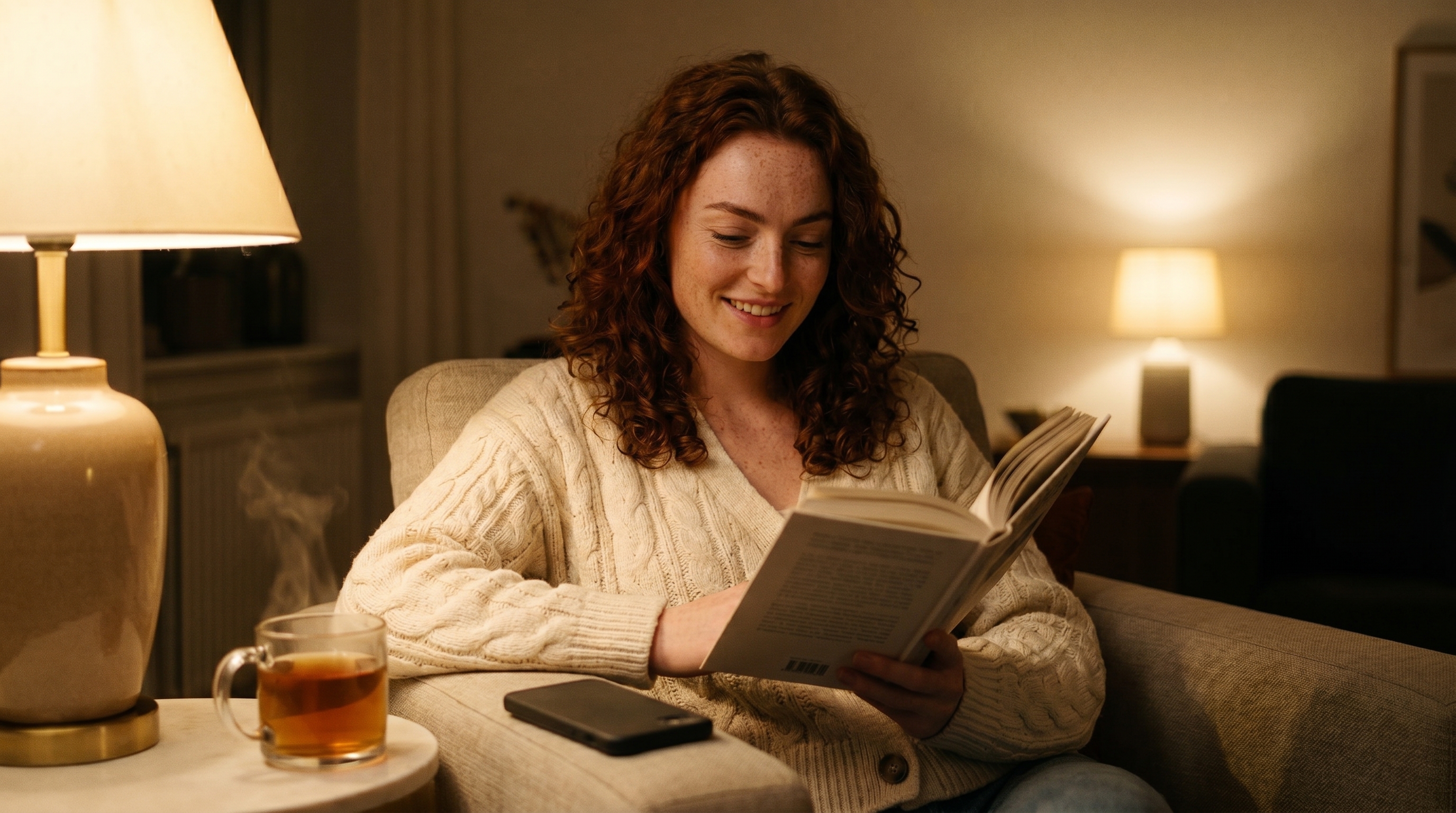
I used to tell myself the scrolling before bed was relaxing.
It took me a long time to notice that I never actually felt relaxed afterward. I felt slightly wired. Slightly behind on something I could not name. Slightly more aware of other people's lives than my own. And then, almost without exception, I would take longer to fall asleep than I expected to.
The relaxation I thought I was getting was a story I was telling myself about a habit that was doing something quite different.
What is actually happening when you scroll before bed
It is not just the blue light, though that is part of it — blue wavelength light suppresses melatonin production, delaying the body's natural signal that it is time to sleep.
The bigger issue is what the content itself is doing to your nervous system. Social media is engineered, deliberately, to produce small hits of dopamine through novelty, social comparison and emotional triggering — outrage, envy, longing, urgency. These are not relaxing emotional states. They are activating ones.
You are asking your nervous system to wind down while simultaneously feeding it a stream of content designed to keep it activated. The two goals are in direct conflict, and the content almost always wins, because it is specifically engineered to.
This is why you can spend an hour "relaxing" on your phone and end up feeling more keyed up than when you started — and why sleep, when it finally comes, is often lighter and more fragmented than it would have been otherwise.
The cost beyond sleep
Sleep disruption is the most discussed cost, but it is not the only one.
Comparison fatigue. The last input your brain receives before sleep is frequently a curated, idealised version of other people's lives. This information does not simply disappear when you close the app. It gets processed during sleep, and women who scroll extensively before bed report higher next-morning anxiety and lower self-esteem than those who do not, according to several studies on bedtime social media use.
Emotional processing displacement. The hour before sleep has traditionally been time for emotional processing — reflecting on the day, however informally. When that time is filled with external input instead, the processing does not happen. Unprocessed emotional material does not disappear; it often resurfaces as the racing thoughts that arrive once the phone is finally down and the room is quiet.
The illusion of rest. Perhaps the most insidious cost. Scrolling feels passive, which creates the impression of resting. But the cognitive and emotional activation involved means very little actual restoration is happening. Women report the most genuine restoration from activities that are quiet, low-stimulation and free of social comparison — reading fiction, a bath, journaling, simply sitting. Scrolling rarely makes that list, even though it is the most common evening activity.
What a digital sunset actually is
The concept is simple: a deliberate, consistent transition away from screens in the hour before bed, replaced with something that genuinely signals rest to the nervous system.
This is not about eliminating technology from your life or becoming rigid about screen time. It is about protecting one specific window — the hour before sleep — because that window has an outsized effect on both your sleep quality and your emotional state the next day.
How to build one without it feeling like deprivation
Choose a consistent time. The same time each night, ninety minutes before you intend to sleep. Consistency matters more than the exact time chosen — it allows your nervous system to anticipate and prepare for the transition.
Have something ready to replace it, not just remove it. Willpower alone rarely beats a phone's pull. Have a book already open on the side table. Tea already prepared. A journal already out. Remove the friction from the better choice and add it to the worse one — phone charging in another room is more effective than simply deciding not to pick it up.
Dim the lights alongside the screens. This compounds the signal to your nervous system. Warm, low light combined with the absence of a screen creates a much stronger cue for the brain to begin producing melatonin than either change alone.
Notice what you actually want to do, once the option of scrolling is removed. Most women discover, after a week or two, that they missed reading, or journaling, or simply sitting with their thoughts, far more than they expected to. The scrolling was filling a space, not occupying a preference.
Allow the first few nights to feel strange. The pull toward the phone in that ninety-minute window is genuinely a habit loop, reinforced by months or years of repetition. It takes roughly two weeks of consistency for a new evening pattern to feel as automatic as the old one did.
What changes
Within the first week, most women notice falling asleep faster — not dramatically, but measurably.
Within two to three weeks, the quality of the sleep itself often shifts — fewer middle-of-the-night wakings, a sense of having slept more deeply even without a tracker to confirm it.
And less discussed but equally real: the morning anxiety that so many women treat as a baseline personality trait often softens. Not because anything else has changed, but because the last input before sleep is no longer a stream of comparison and urgency.
The reclaimed hour
This is, in the end, not really about screens. It is about an hour of your day that has quietly been outsourced to other people's content, other people's lives, other people's curated versions of themselves.
That hour is yours. It always was.
The digital sunset is simply the practice of taking it back.
Join the Inner Circle
Seraphina's Weekly Letters
Weekly wellness notes for women who are quietly becoming.