I did not set out to make a hormone-balancing recipe.
I set out to make something that would stop the week before my period from feeling like a different body had taken over. The irritability. The bloating that appeared from nowhere. The cravings that made no sense. The exhaustion that a full night of sleep did not touch.
I started reading the research. And what I found was not a supplement protocol or a detox plan. It was a bowl.
Specific ingredients. Specific reasons. A meal I could make on a Sunday and eat across three days that systematically supports the hormone pathways most affected in the luteal phase.
Here is the recipe — and more importantly, here is why each thing in it is there.
The Hormone-Balancing Bowl
Serves 2 | Prep: 20 minutes | Cook: 35 minutes
What you need
For the base:
- 1 cup black rice (or brown rice if unavailable)
- 2 cups water or vegetable stock
For the roasted vegetables:
- 1 large head of broccoli, cut into florets
- 1 cup edamame, shelled (frozen is fine)
- 2 tablespoons olive oil
- Sea salt and black pepper
For the bowl:
- 2 soft-boiled eggs
- 1 ripe avocado, sliced
- 4 tablespoons pickled red cabbage (store-bought or homemade)
- 1 tablespoon sesame seeds
For the miso tahini dressing:
- 3 tablespoons tahini
- 1 tablespoon white miso paste
- 1 tablespoon rice vinegar
- 1 teaspoon fresh ginger, grated
- 1 tablespoon maple syrup or honey
- 3 to 4 tablespoons water to thin
How to make it
Cook the black rice according to packet instructions — typically 35 minutes in stock, covered, on a low simmer. This can be done ahead and refrigerated.
Preheat oven to 200°C (400°F). Toss broccoli florets in olive oil, salt and pepper. Roast for 20 to 25 minutes until edges are charred and florets are tender with texture remaining. In the last five minutes, add edamame to the tray to warm through.
Soft-boil eggs by bringing water to a boil, lowering eggs in gently, and cooking for exactly 6 minutes and 30 seconds. Transfer to cold water immediately to stop cooking. Peel when cool.
Make the dressing by whisking all dressing ingredients together. Add water gradually until it reaches a pourable consistency. Taste and adjust — more miso for salt, more vinegar for brightness, more maple for balance.
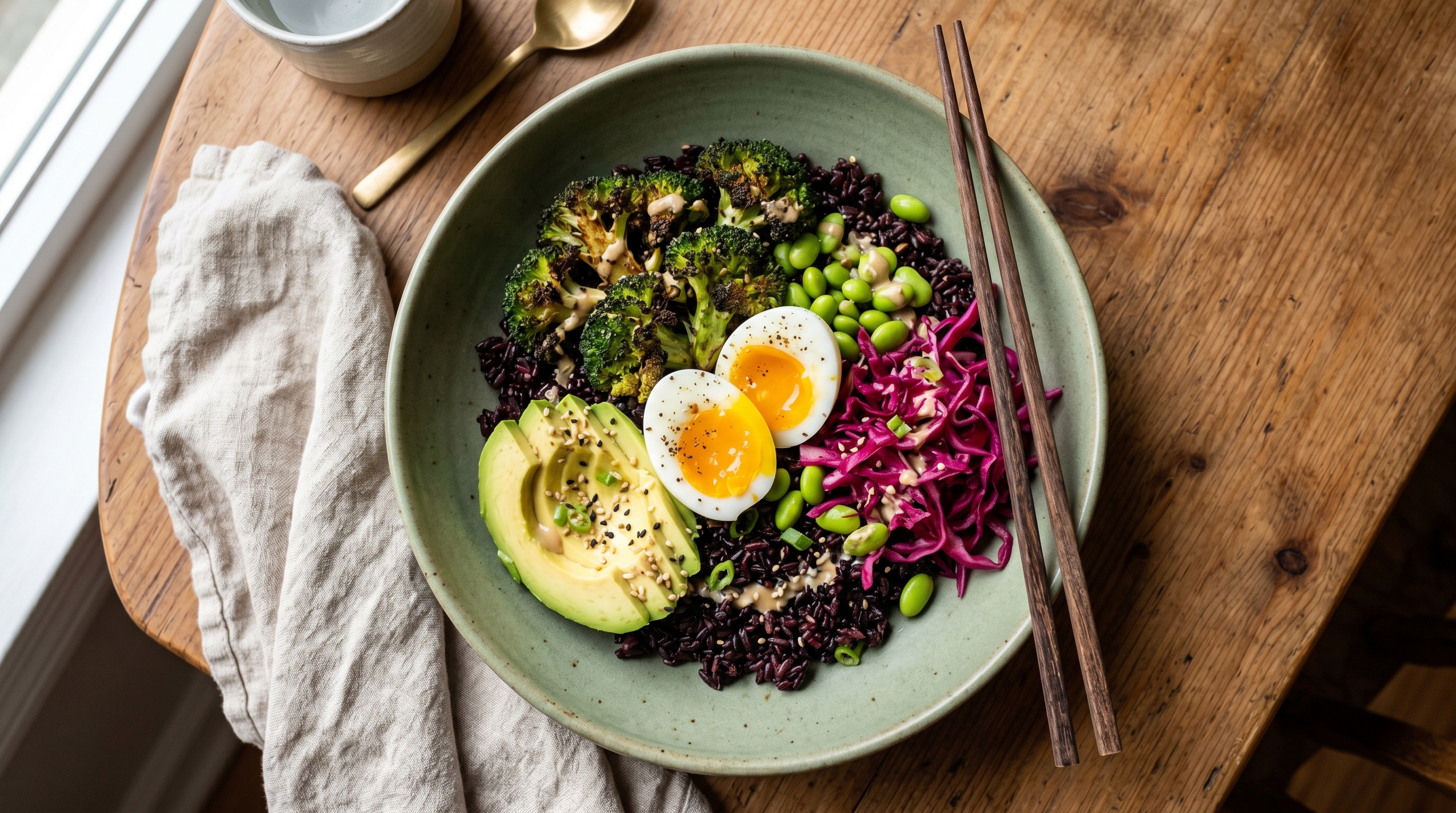
Assemble: rice base, roasted broccoli and edamame, sliced avocado, halved eggs, pickled cabbage. Drizzle generously with dressing. Scatter sesame seeds.
Why every ingredient is in this bowl
Black rice is in the base because of its anthocyanin content — the same compounds that make blueberries valuable. Anthocyanins reduce systemic inflammation, and systemic inflammation is one of the primary amplifiers of PMS symptoms. Black rice also has more fibre than white rice, which supports estrogen clearance through the digestive system.
Broccoli is the most important ingredient in this bowl. It contains a compound called indole-3-carbinol (I3C), which supports the liver's ability to metabolise excess estrogen. Many PMS symptoms — including bloating, breast tenderness and mood disruption — are driven by estrogen dominance relative to progesterone. Broccoli, and cruciferous vegetables generally, directly support the detoxification pathway that addresses this. Two cups of broccoli weekly is the evidence-backed threshold.
Edamame provides plant-based protein and phytoestrogens — specifically isoflavones. These are weaker than the body's own estrogen and work by occupying estrogen receptors, which in cases of excess estrogen can produce a net moderating effect. The research on soy isoflavones and PMS is genuinely mixed, but for women with estrogen-dominant symptoms, the moderate amounts in whole edamame are well within the range supported by the evidence.
Avocado provides the healthy fats required for hormone synthesis. Sex hormones are made from cholesterol and dietary fat. A diet too low in quality fat directly impairs the body's ability to produce progesterone — the calming hormone that counterbalances estrogen in the second half of the cycle. Avocado also provides magnesium and potassium, both of which reduce PMS-related water retention.
Soft-boiled egg is the protein anchor. Protein at every meal stabilises blood sugar — and blood sugar instability in the luteal phase directly amplifies mood swings, cravings and fatigue. The egg also provides choline, which supports liver function, and B12, which is required for progesterone synthesis.
Pickled red cabbage adds fermented benefit — live cultures that support the gut microbiome. The gut-hormone connection is significant: gut bacteria produce an enzyme called beta-glucuronidase which, when overproduced, can reactivate estrogen that the liver has already processed for elimination. A healthy, diverse gut microbiome keeps this enzyme at appropriate levels. One to two tablespoons of fermented food daily is the minimum effective dose.
Miso tahini dressing brings together two hormone-supportive elements. Tahini is one of the richest food sources of sesamin — a lignan that modulates estrogen metabolism. White miso provides additional fermented benefit and adds umami depth that makes the bowl genuinely satisfying rather than virtuous. A bowl that feels like a meal — not like medicine.
Sesame seeds scattered on top are not garnish. They are one of the highest food sources of zinc available in a plant form. Zinc is required for progesterone production and is also directly involved in reducing inflammation. Most women are mildly deficient in zinc without knowing it.
When to eat this
The luteal phase — the two weeks between ovulation and the start of your period — is when hormone-supportive eating matters most. This bowl is specifically designed for that window.
If you track your cycle, make this from day 15 onwards. Make a double batch on Sunday. Eat it three times across the week.
If you do not track your cycle, eat it whenever you want. The ingredients are supportive regardless of cycle phase. The specific benefit in the luteal phase is simply more pronounced.
What shifts
Not overnight. But within two to three cycles of eating this way consistently in the second half of the month, most women report a reduction in the severity of PMS symptoms — not their elimination, but their reduction to something that no longer runs the week.
That is not a dramatic claim. It is what happens when you stop working against your own hormonal biology and start working with it.
One bowl at a time.
Join the Inner Circle
Seraphina's Weekly Letters
Weekly wellness notes for women who are quietly becoming.