
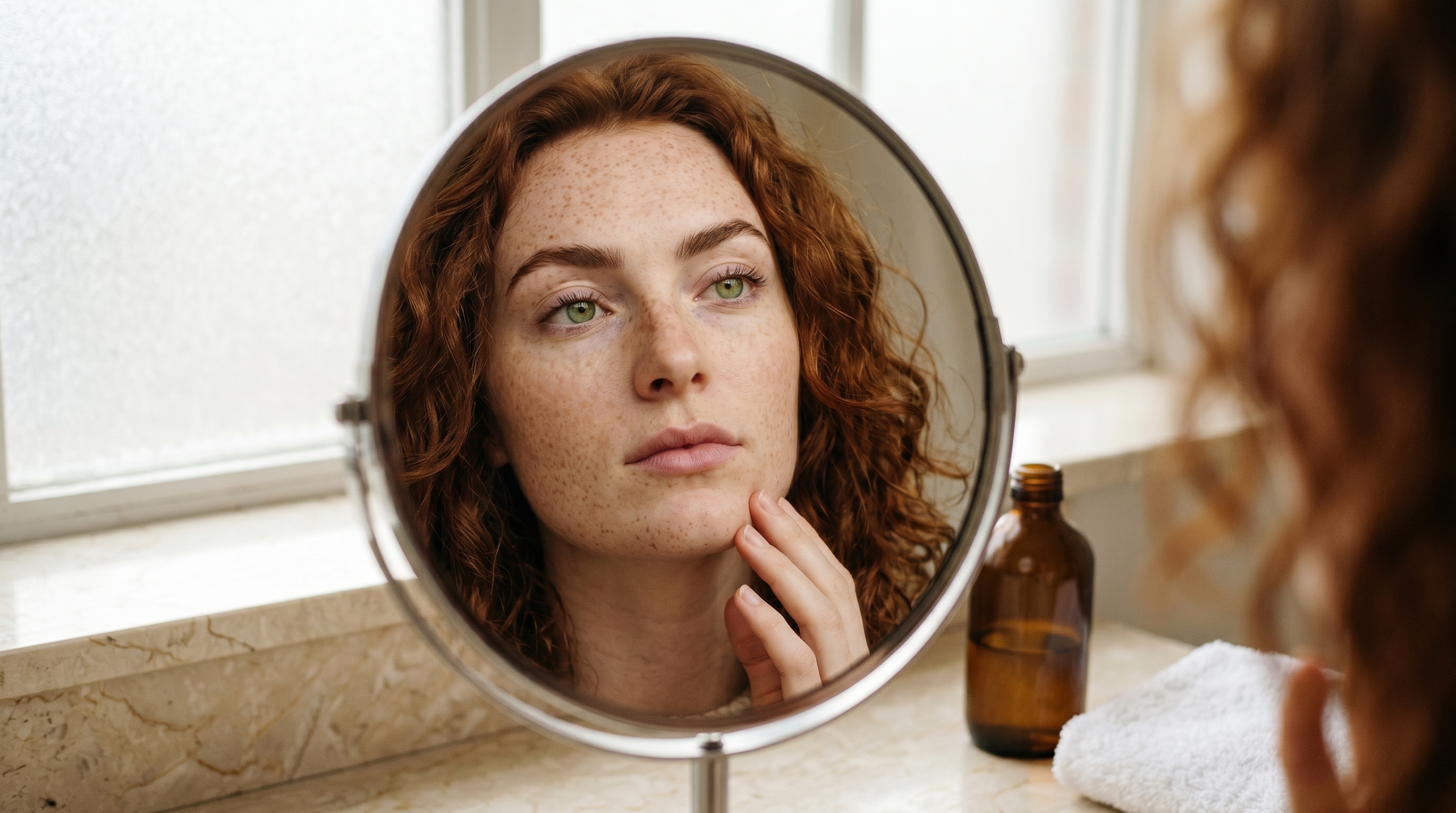
I need to tell you about the moment I realised I had been hurting my own skin for years — and calling it a routine.
It was a Wednesday. I was standing in front of my bathroom mirror with a face that was red, tight, and somehow both oily and flaking at the same time. I had just applied my eleventh product. Eleven. A double cleanse, a toner, a vitamin C serum, a niacinamide, a retinol, a hyaluronic acid, a moisturiser, an eye cream, a spot treatment, an SPF, and a setting mist. My bathroom shelf looked like a pharmacy. My skin looked like it was under siege.
And I thought — what if the problem is not what I am missing, but what I am doing?
The Routine That Was Destroying My Barrier
Here is what nobody in the skincare industry will tell you directly, because it is bad for business: most women are over-treating their skin.
Research published in the British Journal of Dermatology has shown that the skin barrier — the outermost layer called the stratum corneum — functions as a sophisticated ecosystem. It has its own pH, its own lipid matrix, its own microbial community. When you layer multiple active ingredients on top of each other daily, you are not feeding the skin. You are stripping it of its ability to regulate itself.
The specific culprit for me was something millions of women use every single night without questioning it: a high-concentration active acid.
I was using a 10% glycolic acid toner every evening, followed by retinol. The acid was dissolving the outermost layer of dead cells — which sounds like a good thing until you understand that those "dead cells" are the barrier. They are the mortar between the bricks. Without them, everything underneath becomes exposed, reactive, and inflamed.
"Your skin barrier is not a wall to break through. It is a living shield. Every product that promises to 'penetrate deeply' is telling you it bypasses your skin's own protection."
The Signs I Missed For Months
The symptoms of a damaged barrier are so common that most women think they are just "their skin type." I certainly did. Here is what I was experiencing and dismissing:
Tightness after cleansing. I thought that squeaky-clean feeling meant my cleanser was working. In reality, a study published in the International Journal of Cosmetic Science found that post-cleanse tightness is a direct indicator of lipid stripping — the removal of the natural oils your skin produces to protect itself.
Oiliness that kept getting worse. I was using mattifying products because my skin was oily. But the oiliness was compensatory — my skin was overproducing sebum because I had stripped its natural lipid layer. The more I mattified, the more it produced. A vicious cycle documented extensively in dermatological literature.
Redness that I blamed on sensitivity. I told myself I had "sensitive skin." I did not. I had sensitised skin — skin that had been made reactive by the very products I was using to fix it. Research from the Journal of the European Academy of Dermatology distinguishes clearly between these two: genetic sensitivity is rare; product-induced sensitisation is epidemic.
Breakouts that never fully resolved. The constant chemical exfoliation was creating micro-tears in my barrier, allowing bacteria to penetrate layers they would never normally reach. I was treating the breakouts with more actives, which created more barrier damage, which created more breakouts.
What I Removed — And What Happened
I stopped the glycolic acid toner. Completely. No weaning off, no reducing frequency. I just stopped.
For the first week, nothing changed. My skin was confused. It had been receiving chemical signals to shed cells at an accelerated rate for over a year, and suddenly the signal stopped.
Week two, the redness began to calm. Not dramatically — but enough that I noticed I was not reaching for concealer with the same urgency.
Week three, the oiliness shifted. My T-zone was still producing oil, but it was not the desperate, shiny overproduction I had normalised. It was just skin doing what skin does.
By week six — and this is the part that still surprises me — the texture of my face changed. The roughness I had been trying to exfoliate away was gone. Not because I had removed it, but because my skin had rebuilt its own barrier once I stopped destroying it.
A dermatological review published in Clinical, Cosmetic and Investigational Dermatology confirms this timeline. The skin barrier takes approximately four to six weeks to repair itself when the damaging agent is removed — assuming adequate hydration and lipid support.
The Routine I Use Now
Three products. Morning and night. That is it.
A gentle cream cleanser — no foaming agents, no sulfates, no exfoliating beads. Something that removes dirt and makeup without stripping lipids. I use it once a day, at night. In the morning, I splash with water only.
A simple moisturiser with ceramides. Ceramides are the lipids that your barrier is made of. Applying them topically gives the barrier the building blocks it needs to repair itself. Research in the Journal of Clinical and Aesthetic Dermatology found that ceramide-containing moisturisers measurably improved barrier function within two weeks.
SPF in the morning. Non-negotiable. UV damage is the single largest external contributor to premature skin ageing, and a compromised barrier makes you more vulnerable to it.
That is the entire routine. No acids. No retinol. No vitamin C. No twelve-step protocol.
The Truth About "More"
The skincare industry is built on the idea that your skin needs more. More steps, more actives, more innovation. And some of those products are genuinely excellent — in isolation, at the right concentration, for the right skin, at the right frequency.
But layering them all, every day, without understanding what your barrier can tolerate? That is not a routine. That is an assault your skin is too polite to scream about — so it whispers through redness, breakouts, and texture you cannot fix.
If your skin has been "difficult" for months despite doing everything right, consider the possibility that everything right is too much. Remove the harshest thing in your routine. Give your skin six weeks of quiet. And watch what it does when you finally stop fighting it.
— Seraphina
Support Your Skin From the Inside
If stress, hormones or gut imbalance have been showing up on your skin, the Skin Glow Guide explores what is happening beneath the surface — and what actually works.
Read the Skin Glow GuideJoin the Inner Circle
Seraphina's Weekly Letters
Weekly wellness notes for women who are quietly becoming.